
1. The issues
Let’s be honest. If we want to decarbonise the economy it will require making some hard trade-offs.
Instead of rising to the challenge, the major parties are entertaining distractions; the LNP with nuclear and Labor with offshore wind and green hydrogen. Not only are these options hugely expensive, but Australia is a long way from having the skilled workforce and industrial capability to execute them.

The evidence indicates that expanding solar and onshore wind generation, supported by firming generation, is the most affordable and achievable way to ensure we have adequate energy supply as the ageing coal fleet reaches the end of its life.
2. Our plan
- Incentivise battery storage for households and businesses to reduce the stress that intermittent solar puts on the grid
- Target the largest incentives towards lower-income households and small businesses with a sliding-scale where incentives are less for higher-income households
- Create a federal program to roll out distributed solar and storage at schools, social housing and other government and community properties
- Require that states release long-term plans for the development of their Renewable Energy Zones (following the example set by NSW)
- Re-nationalise poles and wires through a fair process, enabling government to:
- Take ownership of the transmission upgrades required to open up renewable energy zones
- Deploy batteries at strategic grid locations/substations to most effectively support the scale-up of intermittent renewable energy (noting that under current regulatory structures network owners are forbidden from building batteries because they are forbidden from owning ‘generation’ assets)
- Avoid ‘gold plating’ the power grid by doing away with rate of return regulation that incentivises private network owners to overbuild infrastructure
- Efficiently operate the transmission and distribution system and maximise the value of rooftop solar by utilising dynamic operating envelopes
- Provide adequate compensation for landowners who host new transmission lines on their property or are impacted by lines nearby
- Reform planning processes so that large-scale renewable energy projects are reviewed in a timely fashion and are not held up for years on end
- Ensure there are adequate sources of dispatchable generation to provide reliable power as coal plants close
- Invest in the deployment of new long-duration storage technologies
3. The evidence
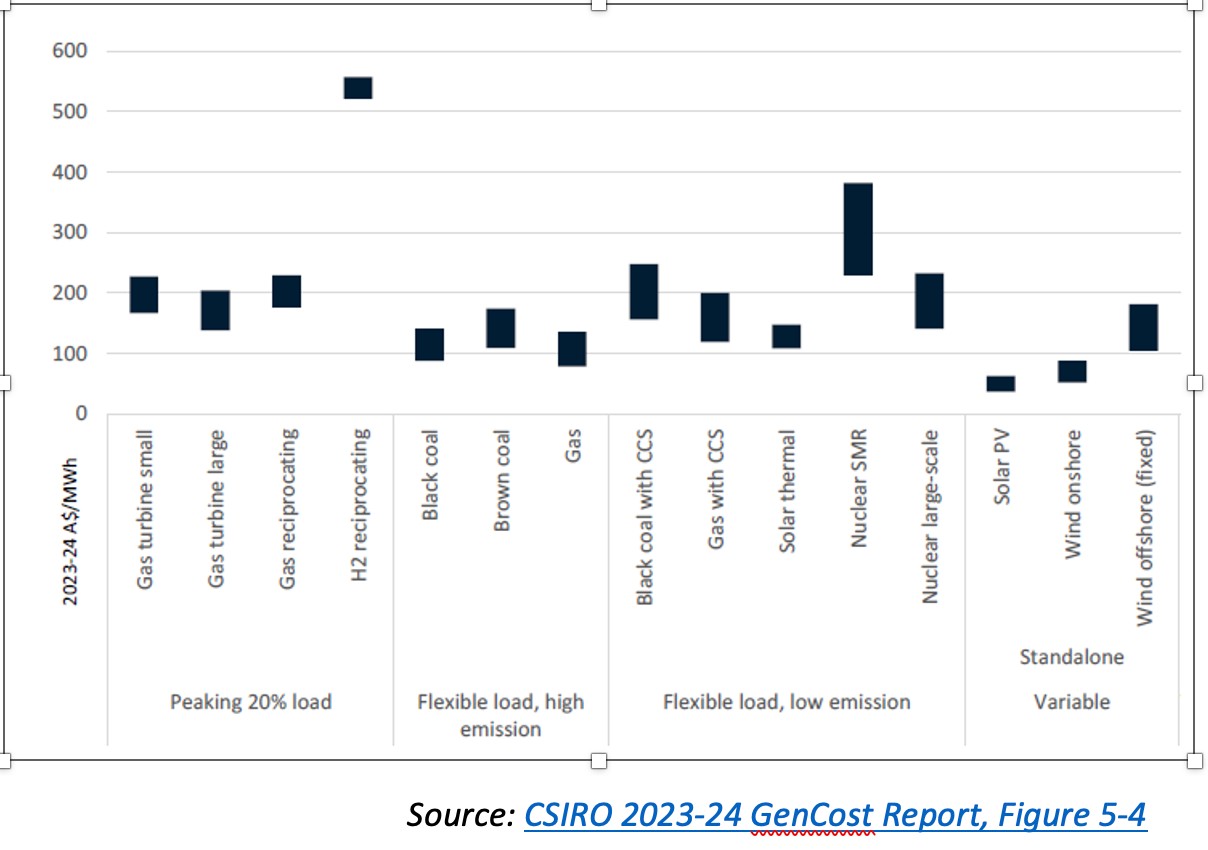
The CSIRO’s annual GenCost report calculates Levelised Cost of Energy (LCOE) for different technologies. The report shows that solar PV and onshore wind are clearly the cheapest sources of energy generation.
LCOE by technology and category – 2030